
Uncategorised
Turbo Actuators: A Critical Component in Modern Turbocharger Systems
Turbocharger actuators are one of the most underestimated yet most critical components in modern forced-induction systems. Whether controlling a traditional wastegate or a variable geometry turbocharger (VGT/VNT), the actuator directly determines boost accuracy, turbo response, fuel efficiency, and engine durability.
A faulty or incorrectly matched actuator can compromise the entire turbo system—even if the turbocharger itself is mechanically sound. This guide explains how turbo actuators work, the differences between pneumatic and electronic designs, common failure modes, and why correct replacement or upgrade is essential for long-term performance and reliability.
What Is a Turbo Actuator and What Does It Do?
A turbo actuator regulates boost pressure by controlling either the wastegate (fixed-geometry turbochargers) or the variable vane mechanism (VGT/VNT turbochargers). By opening or closing these mechanisms, the actuator manages exhaust gas flow through the turbine so the turbocharger delivers the correct boost level across the RPM range.
In practical terms, the actuator affects:
- how quickly boost builds,
- how stable boost pressure remains under load,
- how the engine responds during acceleration,
- and how effectively the engine is protected from overboost conditions.
Types of Turbo Actuators


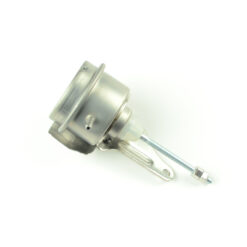
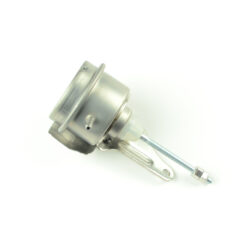


Pneumatic Turbo Actuators
Pneumatic actuators are vacuum- or pressure-controlled and are commonly found in older vehicles and simpler turbo systems. They are typically regulated by a boost control solenoid and are valued for mechanical simplicity and durability.
Key characteristics
- Controlled by engine vacuum or boost pressure
- Often managed via a boost control solenoid
- Mechanically simple and robust
- Cost-effective and generally easier to replace
Common issues
- Diaphragm leaks
- Sticking actuator rod or linkage
- Weak spring or incorrect preload
- Cracked, leaking, or incorrectly routed vacuum lines
Incorrect preload or stroke length is a frequent cause of underboost, overboost, or delayed turbo response after turbo replacement.
Electronic Turbo Actuators
Electronic actuators dominate modern applications, especially with VGT/VNT turbochargers and advanced ECU-driven boost strategies. They provide closed-loop positioning using sensors and allow extremely precise control—often essential for emissions compliance.
Key characteristics
- Controlled directly by the ECU
- Use position feedback (sensor) for accuracy
- Enable precise boost control over a wide operating range
- Common in modern petrol and diesel engines with emissions constraints
Common issues
- Electric motor failure
- Gear wear, binding, or seizure
- Position sensor faults
- Calibration or software mismatch after replacement
Electronic actuators frequently require calibration after installation using diagnostic equipment. Skipping calibration often results in limp mode, fault codes, or unstable boost behavior.
Why Turbo Actuator Condition Is Critical
A worn or malfunctioning actuator can create symptoms that are often misdiagnosed as turbocharger failure:
- Loss of power
- Poor fuel efficiency
- Excessive smoke (especially on diesel engines)
- Limp mode activation
- Overboost/underboost fault codes
- Delayed or uneven boost delivery
In many cases, replacing or upgrading the actuator restores full turbo performance without replacing the entire turbocharger, saving time and cost for both the workshop and the customer.
Wastegate vs. VGT/VNT Control
Wastegate Control
- The actuator opens a bypass valve to limit maximum boost pressure.
- Simpler system with fewer moving parts.
- Common on many fixed-geometry turbo applications.
VGT/VNT Control
- The actuator adjusts turbine vane angles to optimize boost at low and high RPM.
- Improves drivability and supports emissions targets.
- Requires very accurate positioning and reliable feedback control.
Because VGT mechanisms are sensitive to small positioning errors, actuator accuracy and proper calibration are non-negotiable.
Upgrading or Replacing a Turbo Actuator


When replacing or upgrading a turbo actuator, a professional workshop should verify:
- Compatibility with the turbocharger model and housing
- Correct stroke length and mounting geometry
- Proper spring rate and preload (pneumatic actuators)
- ECU communication and calibration requirements (electronic actuators)
- Vehicle-specific boost control strategy and target boost tables
High-quality replacement actuators are engineered to meet or exceed OEM specifications, helping ensure stable boost, fast turbo response, and long service life under high thermal load.
Conclusion


Turbo actuators are not secondary parts—they are precision control devices that directly influence performance, efficiency, and engine protection. Whether pneumatic or electronic, actuator selection and correct setup are essential to avoid repeat issues and deliver consistent boost control.
For mechanics, understanding actuator behavior, failure modes, and calibration requirements can prevent misdiagnosis, reduce comeback rates, and improve customer satisfaction—often without replacing the entire turbocharger assembly.
